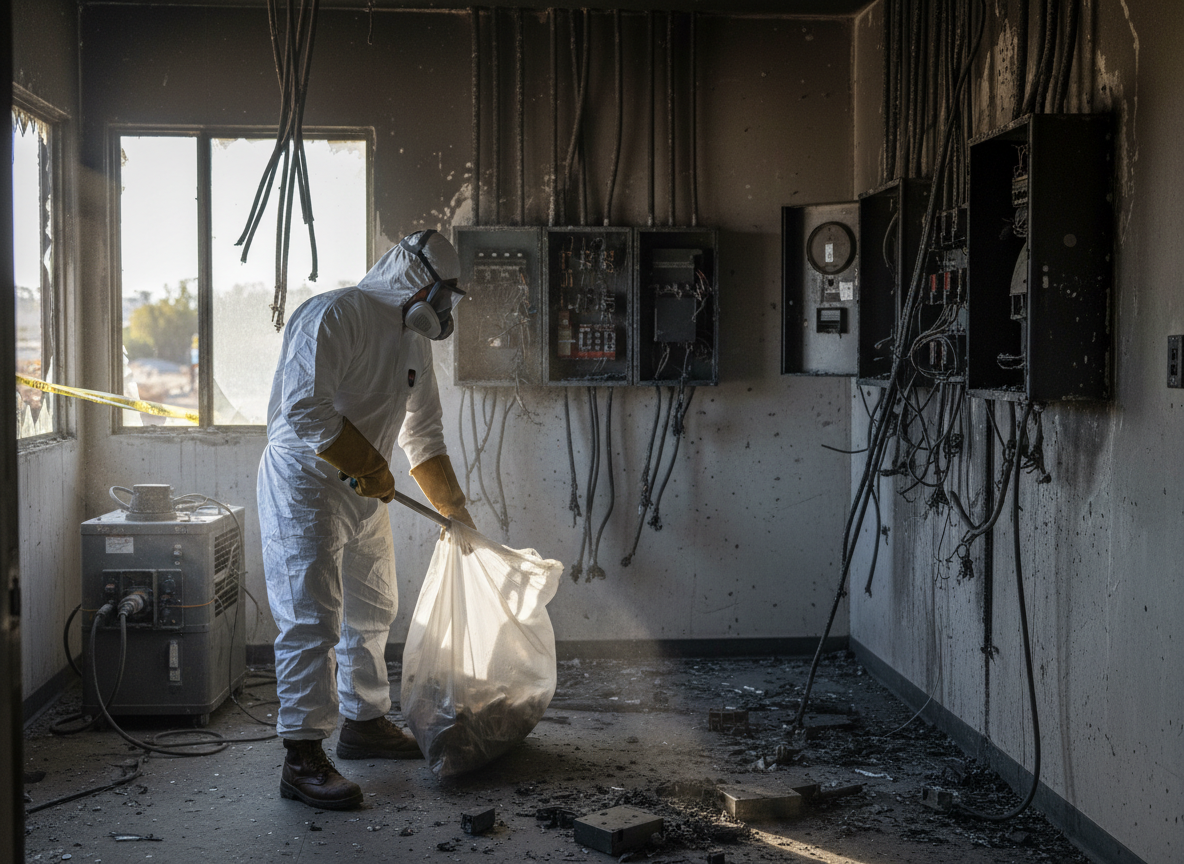
Electrical fires in San Luis Rey often start in older homes along Mission Avenue and nearby streets where aging knob-and-tube or aluminum wiring meets modern loads. Cleanup begins with isolating affected circuits, then removing charred insulation and soot that has penetrated plaster walls and attic spaces common in the area's mid-century housing stock. Technicians must account for the dry climate that lets fine soot travel through HVAC ducts and settle in crawl spaces, requiring negative-air machines and HEPA filtration to prevent recontamination.
San Diego County building codes require verification that all electrical repairs meet current standards before walls are closed, so restoration crews document every removed outlet and junction box. Residue from burned PVC wiring contains hydrochloric acid that can corrode metal fixtures and concrete slabs if not neutralized promptly. In the San Luis Rey area, terrain near the riverbed can channel smoke downward into lower levels of split-level homes, creating hidden pockets of contamination that surface months later during humidity shifts.
Edge cases include fires that travel through shared walls in duplexes near the historic mission district, where soot migrates into neighboring units through unsealed attic spaces. Crews use pH testing on surfaces and specialized sealers on remaining framing to lock in odors before new drywall is installed. Homeowners should expect multiple air exchanges and real-time moisture monitoring because the region's occasional marine layer can slow drying of saturated materials after suppression water is introduced.
Technician insight
In San Luis Rey, the thing that catches most people out with Electrical fire cleanup is how soot travels through the single-wall construction and shared attics found in homes built before the 1970s along Mission Avenue. The dry inland air lets particles stay airborne longer than owners expect, so one missed junction box can re-soot an entire room weeks later when the marine layer rolls in.
Mission Avenue Duplex Electrical Fire
An outlet fire in a 1960s duplex near Mission Ave spread soot through the shared attic into the neighboring unit. We isolated both panels, removed insulation and charred framing on the origin side, then ran negative air across both units to capture particles that had settled in the lower bedrooms. After neutralization and sealing, both sides passed clearance testing and were ready for drywall within five days.
How it works
- 1
Site Assessment and Safety Isolation
Technicians arrive at the San Luis Rey property, shut off power at the main panel, and map all affected circuits before any removal begins.
- 2
Soot and Residue Removal
HEPA vacuums and chemical sponges extract acidic soot from walls, ceilings, and ductwork while protecting undamaged surfaces common in local homes.
- 3
Neutralization and Sealing
pH-neutralizing agents are applied to framing and concrete, followed by odor-sealing primers on all porous materials left in place.
- 4
Final Clearance and Documentation
Air quality readings and surface tests confirm the space meets habitability standards before the property is released for reconstruction.
Pricing
Upfront quotes after on-site inspection of soot migration and material damage.