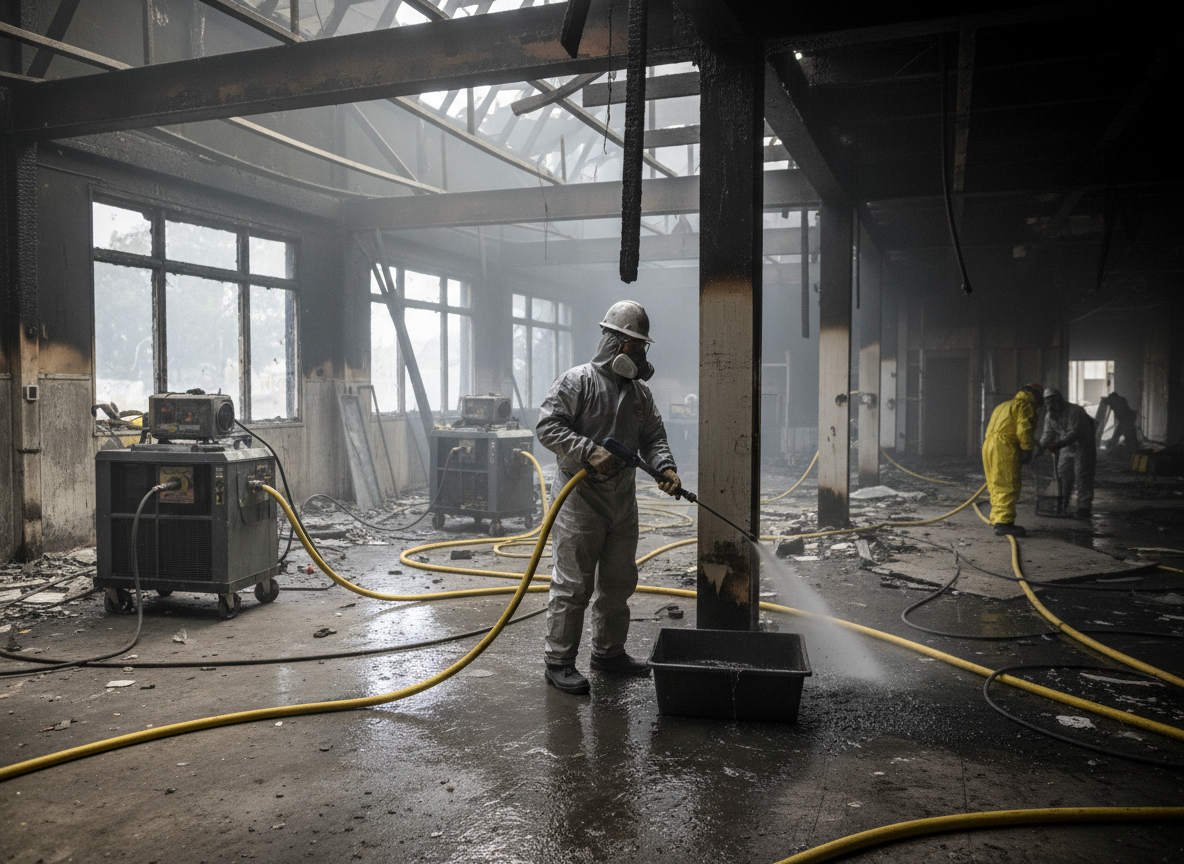
Commercial fire restoration in San Luis Rey often involves older masonry and wood-frame buildings along Mission Avenue and nearby corridors where smoke travels through shared HVAC systems and drop ceilings. Crews must isolate affected zones quickly to prevent soot migration into adjacent tenant spaces, especially in strip centers and light-industrial properties common in the 92068 zip. Salvage decisions hinge on whether metal fixtures, concrete floors or gypsum walls can be cleaned versus replaced, and crews document every step for insurance adjusters who know the area’s mix of pre-1980 and newer construction.
San Diego County fire codes require commercial properties to meet updated egress and suppression standards after a loss, so restoration plans frequently include coordination with local inspectors before reopening. In San Luis Rey, seasonal Santa Ana winds can push smoke deeper into wall cavities and roof assemblies, requiring negative-air machines and HEPA filtration longer than in coastal zones. Technicians test for hidden corrosion on electrical components and HVAC coils, because residual acids from burning plastics continue damaging surfaces weeks after the fire is out.
Edge cases include restaurants and auto shops where grease or petroleum residues create stubborn odors that standard ozone treatments cannot fully address. Restoration teams use specialized degreasers and thermal fogging matched to the fuel load, then verify clearance with air sampling before tenants return. Work is scheduled around business hours when possible to limit revenue loss, and temporary power and security are set up the same day crews arrive at the 4050 Mission Ave base.
Technician insight
In San Luis Rey, the thing that catches most people out with Commercial fire restoration is how quickly smoke moves through the shared roof plenums and single-story strip-center HVAC runs along Mission Ave. Older electrical panels in buildings from the 1970s and 80s often hide acid corrosion that shows up weeks later if you don’t pull the covers and test every circuit.
Strip-center retail fire
A fire started in the back storage room of a Mission Avenue retail space and sent smoke through the common attic. We found heavy soot on ceiling tiles and inside the shared HVAC trunk. Contents were packed out for off-site cleaning, the plenum was sealed and scrubbed, and the space reopened after clearance testing with minimal interruption to neighboring tenants.
How it works
- 1
Emergency Board-Up And Site Secure
Technicians arrive 24/7, board openings, and set up temporary power and fencing to protect the commercial property from weather and unauthorized entry.
- 2
Soot And Smoke Assessment
Detailed inspection identifies smoke migration paths through HVAC, ceilings and wall cavities common in San Luis Rey commercial buildings, with photo documentation for insurance.
- 3
Contents And Structural Cleaning
Contents are inventoried, cleaned or packed out; structural surfaces receive appropriate cleaning methods based on material type and smoke residue.
- 4
Odor Removal And Air Scrubbing
Thermal fogging, ozone or hydroxyl treatments combined with HEPA air scrubbers address lingering odors before final clearance testing.
- 5
Rebuild And Final Walkthrough
Repairs restore the space to pre-loss condition, followed by a walkthrough with the owner and any required municipal inspections.
Pricing
Pricing depends on fire size, affected square footage, smoke penetration and contents scope; upfront quotes provided after on-site assessment.